I’m an NHS Nurse. At 56 I Was Drowning in My Own Sweat at 3 AM Every Night – Until a Consultant Gynaecologist Explained the One Thing No GP Ever Told Me
After eighteen months of nightly sweats, sagging skin, a vanished libido and a body I no longer recognised, I had already started believing my own GP – that this was simply “what fifty does to a woman.” Then I overheard one sentence on a podcast, and everything I’d been told fell apart.

It was 3:14 in the morning on a Tuesday in June, and I was sitting on the edge of my own bed in Morningside with the duvet kicked to the floor and a cold patch under my back the size of a dinner plate.
My nightshirt was stuck to me. My fringe was plastered to my forehead. The window was open and the Edinburgh air outside was cool, and I was still burning.
My husband was three feet away, sleeping. He hadn’t even stirred.
I’d been doing this for eighteen months by then. Up at three. Drenched by half past. Cold and shaking by four. Asleep again – if I was lucky – by five. Awake again, properly this time, at half six. I’d put my uniform on. I’d drive to the Royal Infirmary. I’d spend a twelve-hour shift on my feet looking after other people’s families. And I’d come home so depleted I couldn’t make conversation with my own.
I have been a nurse for thirty-two years. I know what a body in distress looks like. And the woman I was looking at in the bathroom mirror every morning at six o’clock – the dull eyes, the puffy face, the deep new lines either side of her mouth that hadn’t been there at fifty-four – was a woman in distress.
But every doctor I’d asked, including the GP I’d worked with for a decade, had told me the same thing.
“It’s just menopause, Janet. It’s normal. Most women your age go through it. It’ll settle.”
That summer it hadn’t settled for a year and a half.
Why no one in my life knew how bad it had got
I didn’t tell anyone the truth. Not properly.
My daughters – twenty-four and twenty-eight – knew Mum was “tired.” That was the word I used. Tired. Not that I was changing my pillow case at four in the morning because the one underneath my head was wet. Not that I’d stopped going for our Sunday walks because my knees and hips ached in a way I’d never felt before in my life. Not that I’d started buying loose linen tops a size up because everything I owned cut into a stomach that hadn’t been there two years ago.
I didn’t tell my best friend Mary either, even when we met for coffee in Stockbridge. I’d sit across from her and listen to her tell me about her new grandson, and the whole time I’d be sweating quietly through my blouse, hoping she wouldn’t notice. I’d nod. I’d smile. I’d say I was fine.
I had stopped wearing eyeshadow because my eyelids had started to droop and crepe and I couldn’t bear seeing the way it caught in the creases. I had stopped going swimming at the Commonwealth Pool because I didn’t recognise the body in the changing-room mirror anymore. And I had – and this is the bit I find hardest to write – stopped wanting anything to do with my husband in the bedroom, because I felt like a stranger inside my own skin and I couldn’t bear for someone who loved me to touch a body I’d already begun to hate.
If you’d asked me on a good day, I would have said I was managing. If you’d asked me at three in the morning, sat on the edge of a damp bed, I would have told you the truth: I was grieving. I was grieving the woman I used to be, and the GP had told me she wasn’t coming back.
I had started to believe him.
The sentence that broke everything open
It was a Thursday afternoon in July. I was in the car park at the Royal, sitting in my Polo with the engine off and the rain coming down on the windscreen, waiting to go back in for the last four hours of a long shift. I’d put a podcast on because the silence in the car had started to feel dangerous.
It was a women’s health show. I don’t normally listen to those – I get enough medicine at work. But the guest that day was a consultant gynaecologist and obstetrician whose name had been mentioned at a CPD session a colleague had attended the previous spring. She was the one all the senior midwives in our department had been talking about. Dr Darija Strah.
She wasn’t shouty. She wasn’t a wellness influencer. She spoke the way I speak to the patients on my own ward at handover – calm, precise, no nonsense. And about ten minutes in, she said something that made me reach for the volume button and turn it up.
“Three out of every four women over fifty are told that hot flushes, night sweats, sagging skin, weight gain on the belly, mood swings, brain fog and the loss of intimacy are ‘just menopause’ – and that there’s nothing to be done. That is not medicine. That is dismissal. Every one of those symptoms has a single, mechanical cause. And that cause is fixable.” – Dr Darija Strah, Consultant Gynaecologist & Obstetrician
I sat there in the car park and felt every nerve in my body go very, very quiet.
I’d been told nothing to be done by three different GPs. By two consultants I’d seen privately. By a women’s health nurse at my own hospital. And here was a clinician – a serious one, by the sound of her – saying out loud that all of them were wrong.
I picked up my phone right there in the rain and I looked her up. What I found made me sit up in my seat.
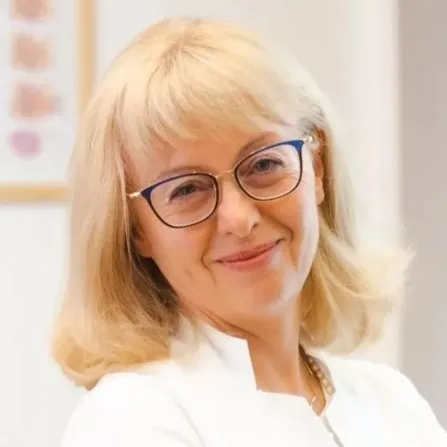
- Consultant Gynaecologist with over 15 years of clinical practice
- Treated more than 18,000 women across her career
- Specialist in hormonal transitions, perimenopause & post-menopausal care
- Lead investigator on clinical studies in phytoestrogen therapy and hormonal restoration
- Invited speaker at more than 20 international women’s health conferences
- Regular contributor to peer-reviewed publications on natural hormone support
- Co-developer of the PhytEstrol™ phytoestrogen complex
This wasn’t a wellness brand. This wasn’t a supplement saleswoman. This was a senior clinician who had spent the best part of two decades quietly building the exact body of knowledge that the system I work in had not, in eighteen months, ever bothered to mention to me.
And she had just said the one thing I’d been waiting eighteen months to hear:
It has a cause. And causes can be addressed.
Hope, after a year and a half of being told to make peace, is a strange feeling. It lands in the chest like a small punch.
The silent collapse after fifty that no GP ever explained to me
Here is what Dr Strah explained on that podcast, and what I sat in the car park for the next forty minutes drinking in the way a thirsty person drinks water.

From your twenties to your mid-forties, a single hormone runs the show in a woman’s body. Quietly. Reliably. Without ever asking for credit. That hormone is oestrogen.
Most people think oestrogen is “the period hormone.” That it just runs your cycle. That when periods stop, you no longer need it.
That is the single biggest medical misconception in women’s health.
How oestrogen quietly runs the whole system
Oestrogen isn’t one of many hormones. It is the master switch.It is the silent foreman that has been running the building site of your body for thirty years, and it has receptors – actual physical landing pads – in almost every system you have.
Throughout your fertile years, oestrogen is what tells:
- your brain’s thermostat (the hypothalamus) to hold core body temperature steady at night,
- your skin cells to produce collagen and hyaluronic acid, the two things that keep your face firm and your skin plump,
- your brain to produce serotonin and GABA – the neurotransmitters that stabilise your mood, calm anxiety, and let you sleep,
- your metabolism to store fat on your hips and thighs rather than around your middle,
- your bones to keep depositing calcium and maintaining density,
- your libido circuitry to respond to your partner – and your blood vessels to dilate, your tissues to lubricate.
It is an elegant, self-sustaining system. It runs silently for decades. As long as oestrogen is flowing, you don’t even know it’s there.
You feel calm. You sleep. Your face holds its shape. Your jeans fit. You want your partner. You remember the name of the woman who has been coming to your book club for six years.
You are, in a word, yourself.
Then, between forty-five and fifty-five, oestrogen falls off a cliff
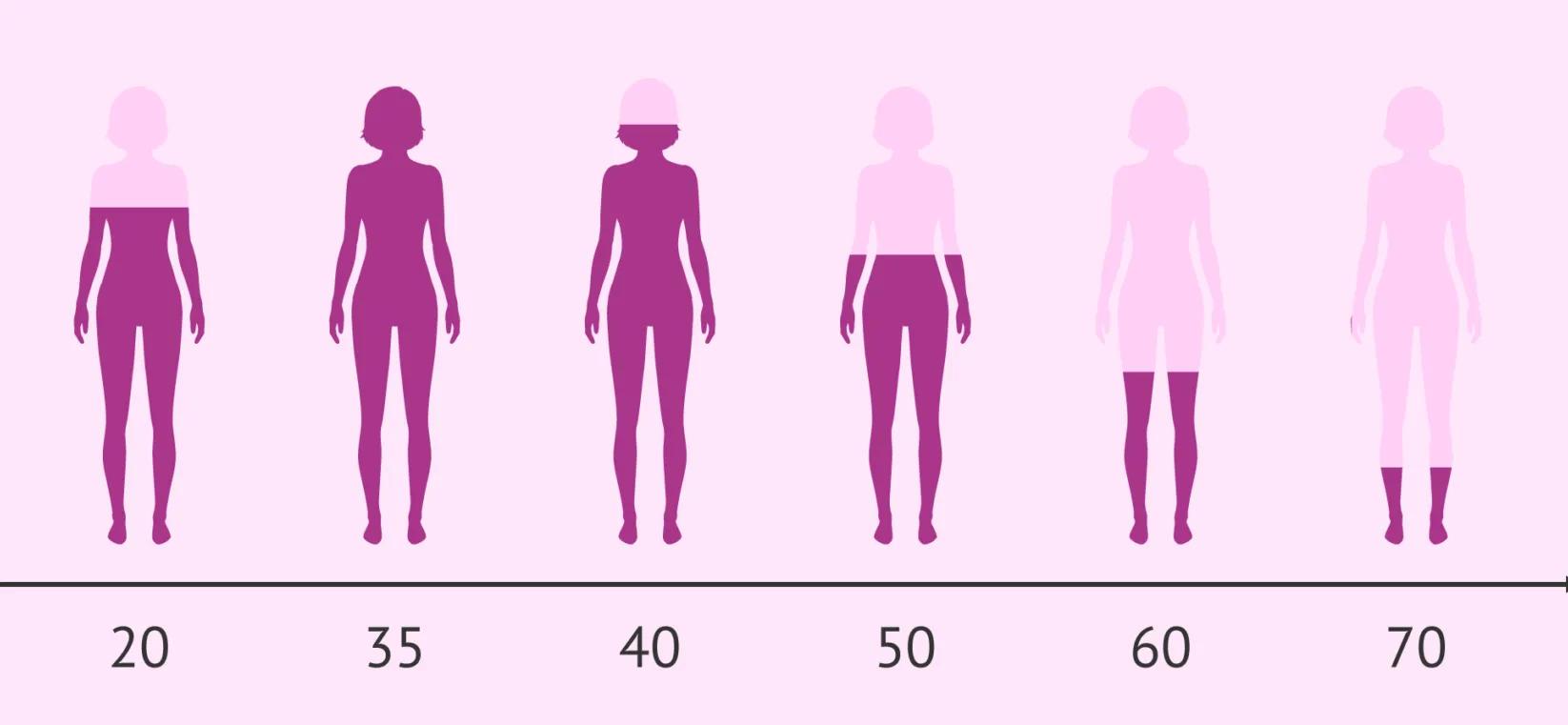
By the time you’ve crossed fully into menopause, your oestrogen has dropped to as little as 10% of what it was in your thirties. Not 10% less. Ten percent of what it used to be.
That is a 90% collapse.There is no other hormone in the human body that drops that far that fast in healthy adults. And the system – your brain, your skin, your bones, your sleep, your metabolism, your libido – all of which was built around a constant, steady oestrogen signal, simply has nothing to do.
This is the cascade Dr Strah drew for me. She called it The Estrogen Cascade, and once you’ve seen it, you cannot unsee it:
The ovaries deplete their final follicles. The master hormone that has run the system for thirty-plus years drops to a fraction of its previous level.
The hypothalamus, which used oestrogen to keep your core temperature steady at night, loses its signal. It now mistakes normal body warmth for overheating – and triggers a full sweat response. This is what a hot flush actually is. It isn’t your body breaking. It’s your brain shouting for an oestrogen signal that isn’t coming.
Oestrogen was the signal that kept your skin’s collagen-producing fibroblasts switched on. Without it, collagen drops faster than at any other point in life. The skin thins. Hyaluronic acid plummets. New deep lines appear around the mouth and eyes – and existing ones double in depth – within months, not years.
Oestrogen was a key co-factor in producing the three neurotransmitters that stabilise mood, drive desire and let you fall asleep. Without it, you wake at three in the morning with your heart racing. You snap at people you love. The libido that used to feel automatic has simply… gone.
Without oestrogen suppressing it overnight, cortisol surges. The body switches from feminine fat distribution (hips and thighs) to visceral storage – the stubborn pad around the middle that doesn’t respond to diet or exercise no matter how hard you try. Insulin sensitivity drops. Joints ache. Energy collapses.
The 3 AM sweats. The face you don’t recognise. The new lines around your mouth. The stomach that won’t shift. The mood swings. The forgotten words. The vanished libido. The aching hips. The flat exhaustion. None of these are character flaws. None of them are you “letting yourself go.” They are the predictable, mechanical output of one hormone falling and one cascade unfolding.
Look at that chain again.
Every single symptom I had been describing to my GP for eighteen months – every one of them – was sitting on that diagram, downstream of one root cause. Not five separate problems. Not “the price of getting older.” Not poor diet or laziness or stress.
One hormone. One cascade.
That was the moment, sat in the car park in Edinburgh with the rain hammering on the windscreen, that I started to cry. Not the despairing kind I’d been doing at three in the morning for a year and a half. A different kind. The kind you cry when somebody finally tells you the truth.
Why HRT terrified me – and why ordinary supplements don’t work
The obvious next question I had – and the one most women in my position have – was: so why am I not just on HRT?
The answer is that I’d been offered it. Twice. And I’d refused both times. My own mother had breast cancer at sixty-two, two years after starting HRT. I am not interested in becoming the next data point in that family history. I’d read the Women’s Health Initiative paper. I’d read the follow-up data on combined HRT and increased risk of breast cancer, blood clots and stroke. And I’d made my own decision, with full information, that synthetic hormones were not for me.
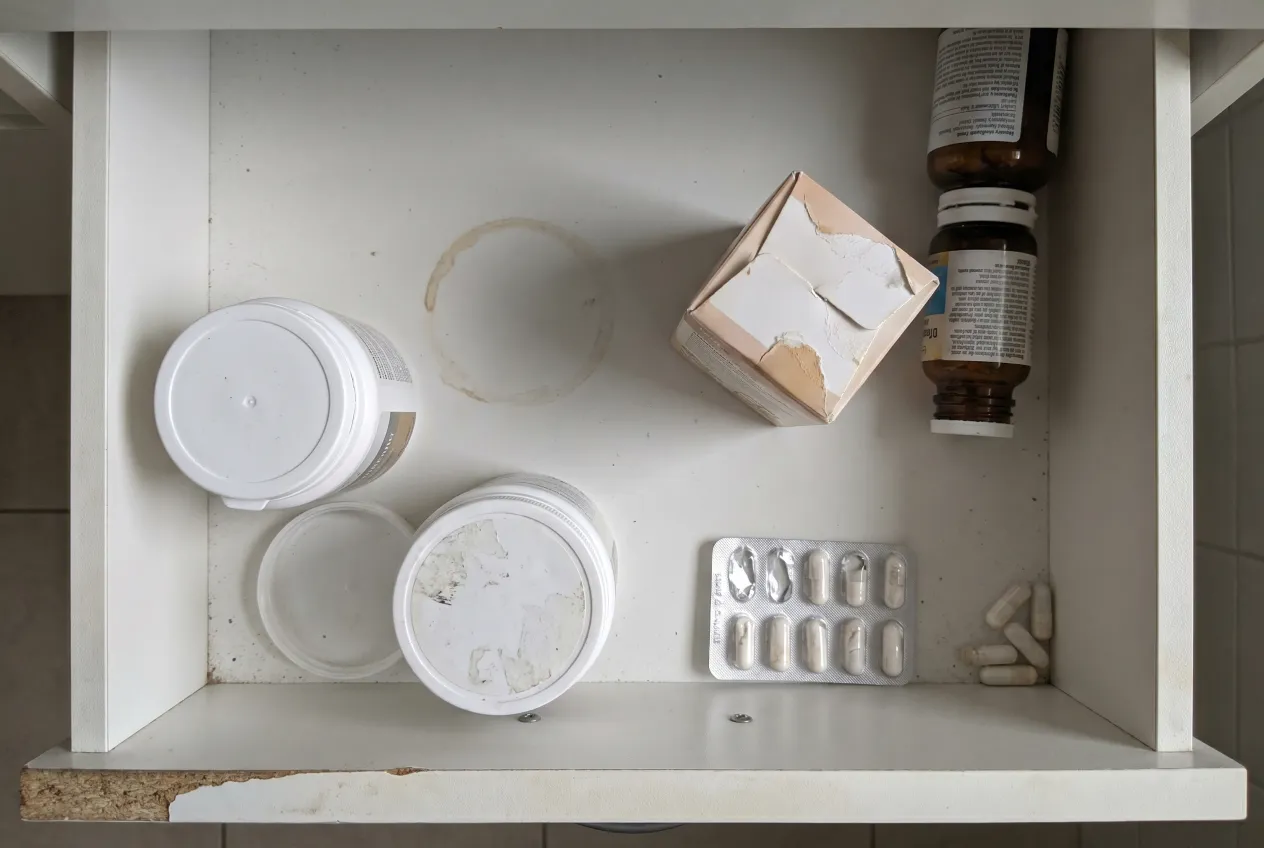
What I’d ended up with instead was a drawer full of high-street supplements. Black cohosh. Soy isoflavone tablets. Sage capsules. Vitamin B complexes. Magnesium. Evening primrose oil. None of them had done anything I could measure.
And here, again, Dr Strah said something that explained why.
Why HRT, creams and ordinary supplements never properly solve this
“HRT replaces the hormone, but it does so with synthetic versions that the body recognises as foreign – and the long-term safety data, especially for combined HRT, has rightly made many women cautious. Skin creams work on the surface but cannot reach the brain’s thermostat, the cortisol axis, or the bones. And most high-street supplements contain phytoestrogens in doses too low, or in forms too poorly absorbed, to make any meaningful difference at the receptor level. What you actually need is a specific phytoestrogen complex – at clinical-grade dose, combined with the cofactors the body needs to use it – that gently mimics oestrogen’s signal across every system at once. That is not what you find on the shelf at Boots.“
That sentence is the reason I stopped buying random supplements. None of mine had the right ingredients. None of them had the right dose. And none of them had the bioavailability enhancer that lets phytoestrogens actually reach the receptors that need them.
What is actually required, Dr Strah explained, is:
- a clinical-grade phytoestrogen blend that gently binds to the oestrogen receptors and restores the signal across the brain, skin, bones and metabolism – without any synthetic hormone,
- a nervous-system adaptogen that calms the overactive hypothalamus so the night-sweat response stops firing,
- a cofactor vitamin (specifically B6) that the body needs to make serotonin, dopamine and GABA – the three neurotransmitters that crash when oestrogen falls,
- a bioavailability enhancer that actually allows the plant compounds to be absorbed and reach the receptors rather than being broken down in the gut,
- a detoxifying green that supports the liver in clearing the metabolic by-products of hormonal recalibration.
You don’t get that combination on the high street. You don’t get it from your GP. And you don’t get it from a tub of soy isoflavones.
The collaboration that changed everything
After two decades of clinical practice and lead-investigator roles on phytoestrogen studies, Dr Strah did something the British medical establishment, frankly, refuses to do for women in their fifties. She built the formula herself.
She collaborated with the European wellness brand Golden Tree to take the exact six-ingredient stack she had been recommending to her private patients – and to put it into a single capsule that any woman could take in the morning with a glass of water.
It’s called My EstroGem.
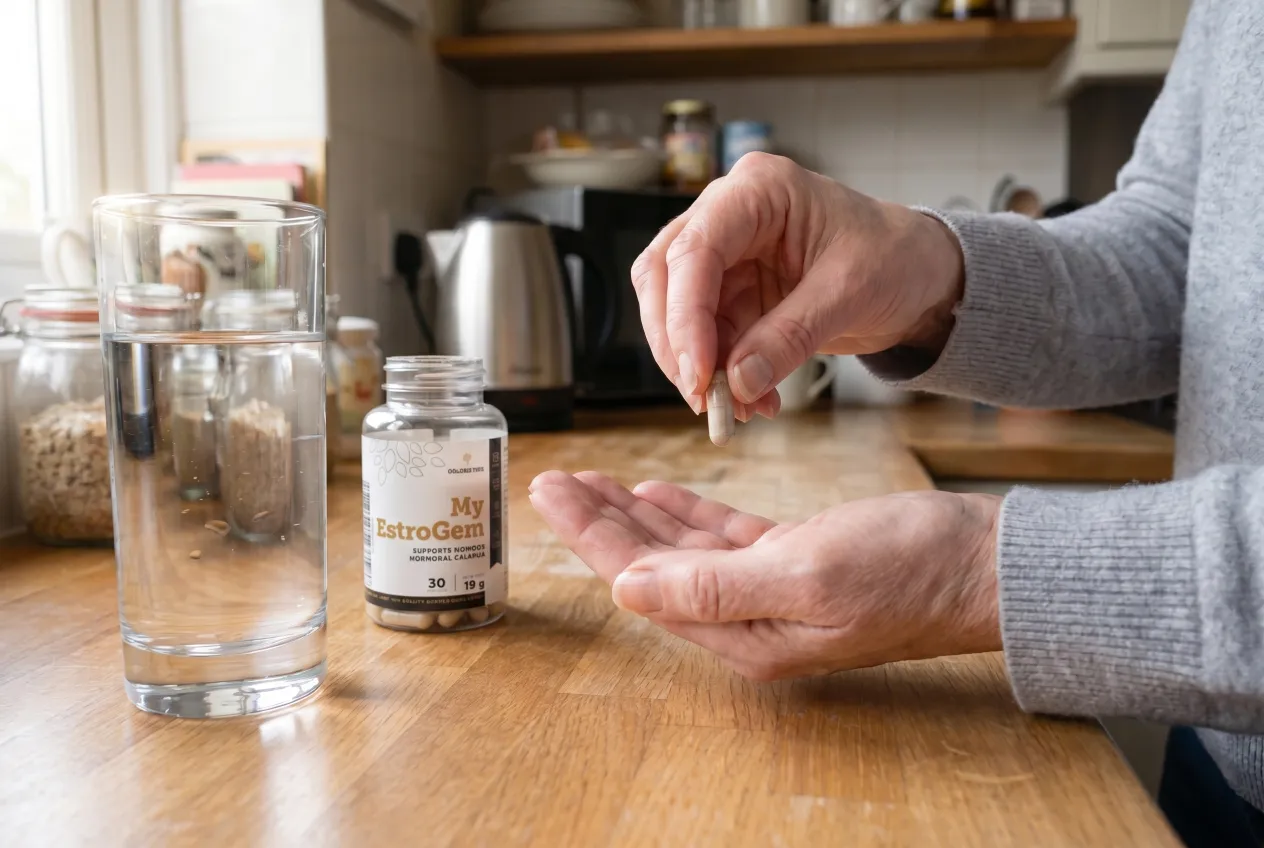
It isn’t HRT. It isn’t a cream. It isn’t anything you have to apply, inject or measure. It is a single capsule, taken once a day, that contains six precisely chosen ingredients – three of them as the workhorses of the formula:
- Chinese Angelica (Dong Quai) extract – the centrepiece phytoestrogen. Used for over two thousand years in East Asian medicine to support women through hormonal transitions, this gentle plant compound binds to the body’s own oestrogen receptors and quietly restores the signal across the brain, skin, bones and mood circuitry. It does not replace oestrogen. It tells the receptors that have been screaming, for years, into silence – I’m here.
- Lignans (PhytEstrol™ complex) – a second, complementary phytoestrogen layer, plus antioxidant protection. Lignans are the plant compounds that long-term studies have repeatedly tied to better cardiovascular health, more stable cholesterol and reduced inflammation in women through menopause. They are also the only phytoestrogens shown to consistently dampen the hot-flush response in clinical trials.
- Lemon balm extract – the nervous-system adaptogen. This is the ingredient that quietens the hypothalamus, takes the heat off the cortisol axis, and lets you sleep through the night again. In clinical research, lemon balm has been shown to reduce anxiety scores by up to 18% in menopausal women within four weeks of consistent use.
And – because plant compounds are only as good as your body’s ability to absorb them – the formula adds three supporting ingredients that the high-street supplements don’t bother with:
- Vitamin B6 – the essential cofactor your body needs to make serotonin, dopamine and GABA. Without it, even the right phytoestrogens cannot rebuild mood and sleep.
- Chlorella powder – a green algae that helps the liver clear the metabolic by-products of hormonal recalibration. (When you are rebalancing a system, you need the bin men, not just the builders.)
- Black pepper extract (piperine) – the bioavailability enhancer that ensures the active plant compounds actually reach your bloodstream rather than being broken down in your gut. This is what separates clinical-grade from supermarket-grade.
“Every woman over fifty deserves this as basic, baseline support. Not as medication. Not as something dramatic. The same way we think about vitamin D in a British winter – as the thing your body simply cannot do without anymore, and that the modern food chain does not supply.” – Dr Darija Strah
My EstroGem is manufactured in the EU in facilities certified to GMP & HACCP standards, is already trusted by more than 1.5 million women, and is backed by a 60-day money-back guarantee.
Four months later, in my own bathroom mirror
I started My EstroGem in late August. One capsule. Morning. Glass of water. Nothing else changed in my life – same job, same shifts, same chaotic NHS week. Here is what I noticed, in the order I noticed it.
- Week one: the 3 AM wake-ups got softer. I still woke up, but the full-blown sweats stopped being full-blown. I’d wake warm rather than soaking.
- Week two: I slept through the whole night for the first time since spring 2023. I cried in the kitchen the next morning. (Quietly. Earl Grey in hand.)
- Week three: the brain fog started to lift. I remembered the name of the new junior doctor on Tuesday morning rounds without having to glance at her name badge – for the first time in six months.
- Week four onwards: the mood swings began to dissolve. I started liking my husband again. (He’d never stopped liking me. I’d just been too exhausted to feel it.)
- By month three: the deep new lines either side of my mouth had visibly softened. My skin felt warmer to the touch, less papery. The waistband of my work trousers had moved down a notch. Two notches, by the end of the month.
- And – the one I wasn’t expecting – by month four: my libido came back. Not loudly. Quietly. Like a friend who had been away for a long trip and had walked back into the kitchen and put the kettle on.

I am not an outlier. The numbers from the clinical research Dr Strah’s team monitored speak for themselves:
In their own words
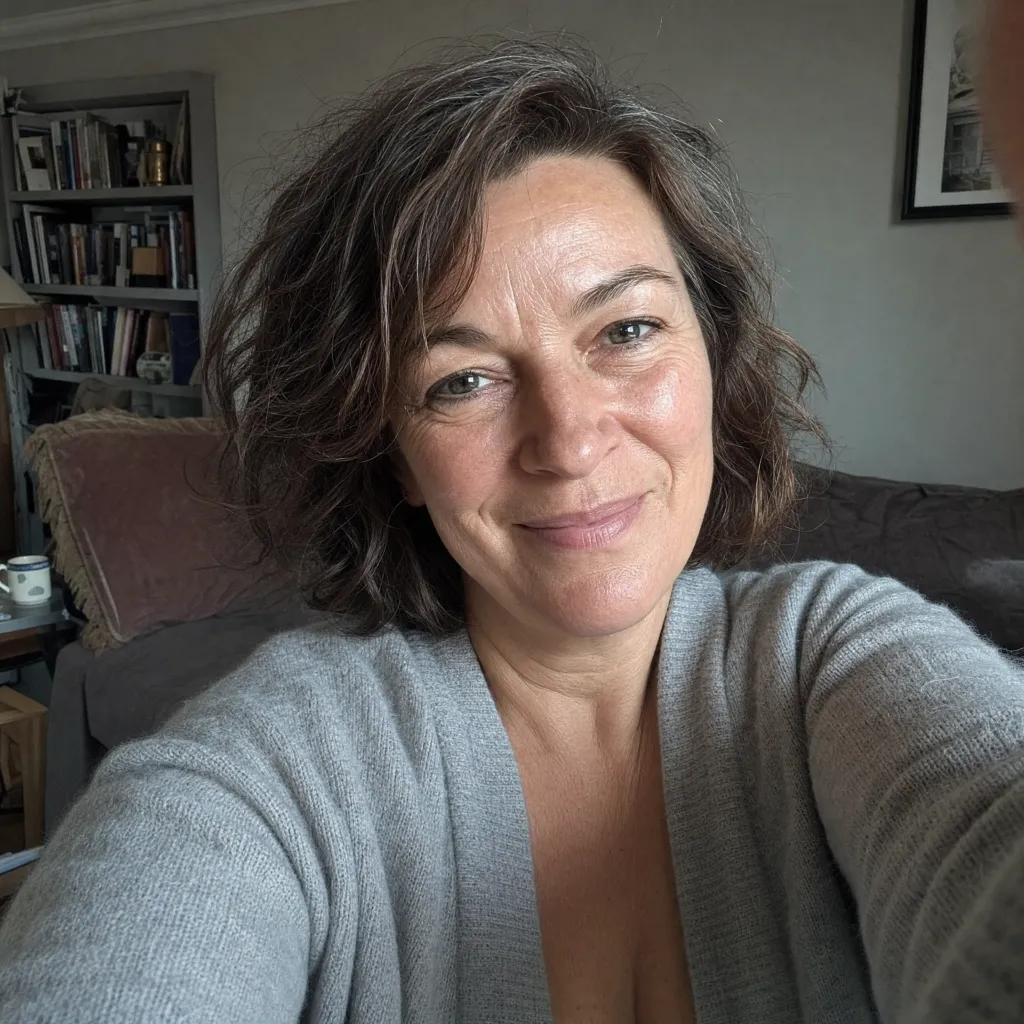
“After just one month on My EstroGem, my hot flushes have all but disappeared and I’m sleeping through the night for the first time in three years. It is like somebody finally turned the thermostat in my body back to where it used to be.”
– Georgina, 54, Manchester ✅ Verified buyer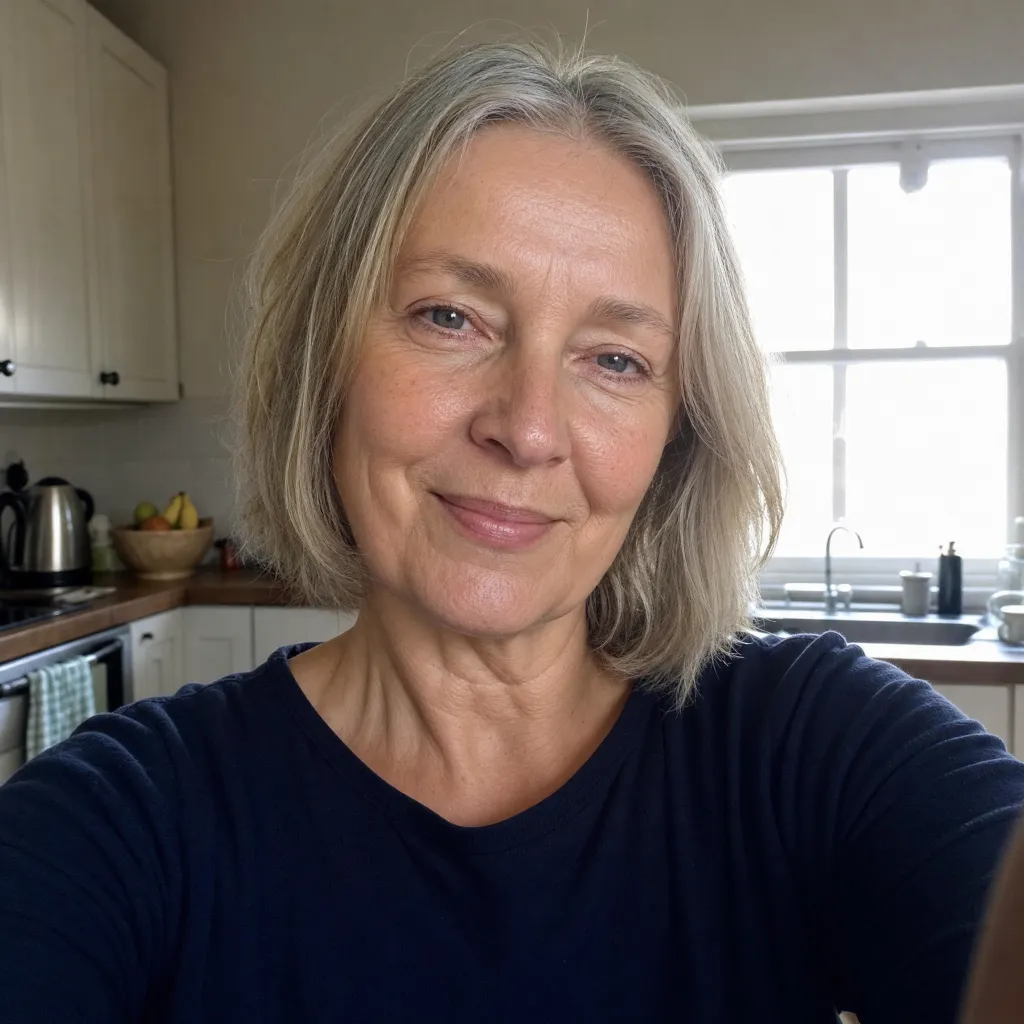
“I had been told by two different GPs that there was nothing to be done. I tried HRT briefly and came off it because of family history of breast cancer. My EstroGem has done what neither HRT nor the high-street supplements ever did. My mood is back, my husband has his wife back, and I can think again.”
– Natalie, 56, Bristol ✅ Verified buyer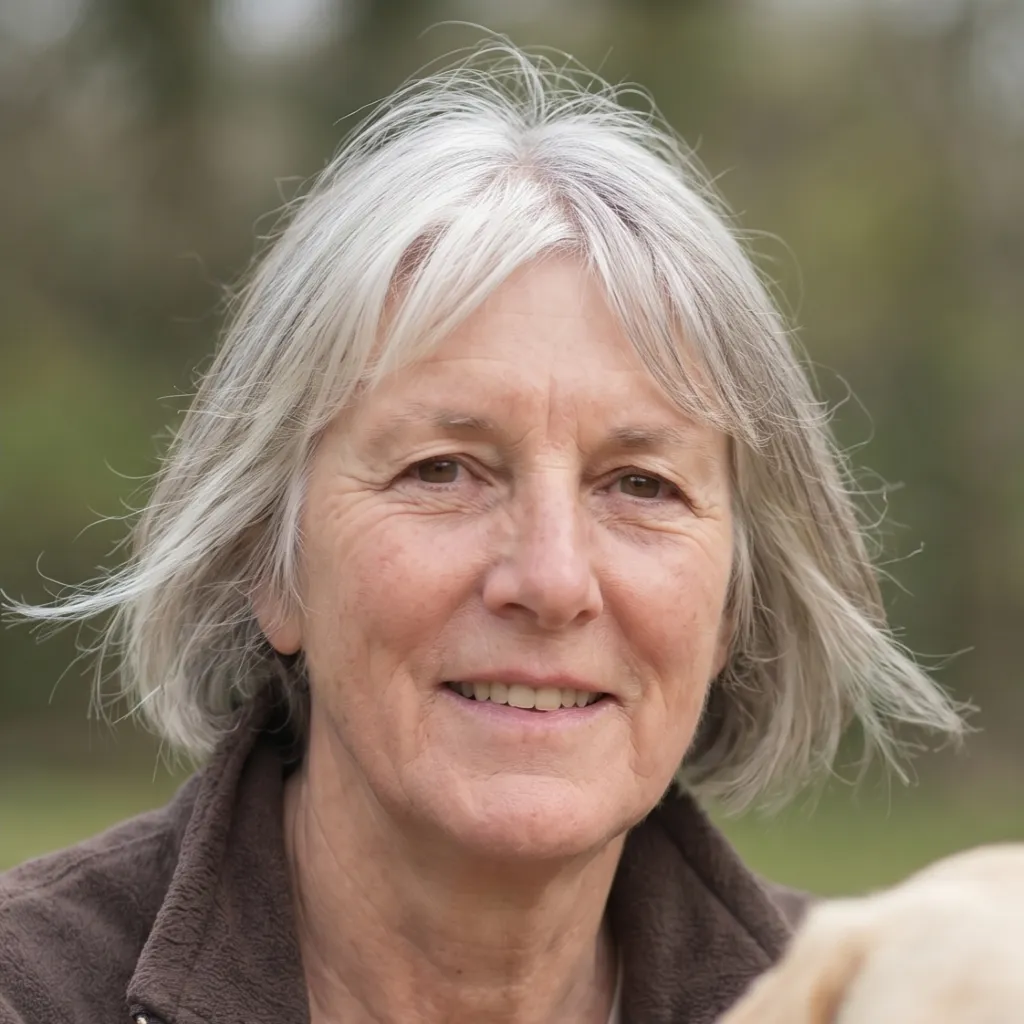
” My latest bone-density scan showed improvement for the first time in years. My GP was speechless. The added energy on top of that has changed my daily walks – I can keep up with my Labrador again instead of dragging him home. At fifty-eight, I genuinely feel younger than I did at fifty-three.”
– Rosalie, 58, Bath ✅ Verified buyer
“Four months in, I have not only lost the stomach I thought was permanent, I feel stronger and more vibrant than I have since my mid-forties. My friends keep asking what my secret is. I tell them honestly: it’s a single capsule, in the morning, with water. That’s it.”
– Vivienne, 55, Edinburgh ✅ Verified buyerWhere to get it
My EstroGem is not sold in Boots, in Holland & Barrett or anywhere on the high street. It is produced in small, controlled batches in EU facilities certified to GMP and HACCP standards, and is available only directly from Golden Tree. A single box would normally retail at £57.90. The longer protocols (three and six months) are currently discounted below retail while the batch lasts – because the women who see the deepest, most stable results are the ones who give the cascade three to six months to fully reverse.
A single 30-day box now comes to £38.90 instead of £57.90 – a saving of £19, or about £1.30 a day.
The 90-day protocol – the one I’d gently steer you towards, because three months is roughly what it took for my own cascade to properly turn – works out at £101.70 instead of £173.70. That’s £72 off, just £1.13 a day, and it comes with the free e-book.
And the 180-day protocol, for the deepest and most lasting change, comes to £167.40 instead of £347.40 – a saving of £180, just 93p a day, with the free e-book included.
Every order is backed by a 60-day money-back guarantee. Even if you’ve finished the entire box and decide it wasn’t for you, Golden Tree will refund the full amount. The entire risk is on them. None of it is on you.
If you recognised yourself anywhere in my story…
See the full formula Dr Strah developed – every ingredient, every clinical-study figure, and how the cascade is reversed in order – on the next page.
SEE THE FULL FORMULA →P.S. If at three in the morning you have started sitting on the edge of your own bed with the duvet on the floor and a cold patch under your back, the way I did for eighteen months – please don’t do what I did. Don’t believe the GP who tells you it’s “just menopause.” Don’t spend another year and a half quietly grieving the woman you used to be. There is a cause. There is a cascade. And there is a formula, developed by a senior consultant gynaecologist, that has helped over 64,800 British women reverse it. At the very least, read what Dr Strah has to say about it on the next page. It may turn out to be the one thing that has been hidden under the rug the whole time – your way back to yourself.